
Look, I'll be honest with you. About six months ago, I was sat in my office staring at a client's website analytics with a look of utter bewilderment on my face. Their beautifully designed site — with all the technical SEO boxes ticked — was tanking in search rankings.
"But WHY?!" I may have shouted at my monitor. My cat, the only witness to this meltdown, offered zero technical advice.
The culprit? Something Google calls E-E-A-T. And if you're scratching your head thinking, "Is that some kind of fancy sandwich?", then pour yourself a cuppa and settle in. This might just be the most important thing you read about content strategy this year.

What the Heck is E-E-A-T Anyway?
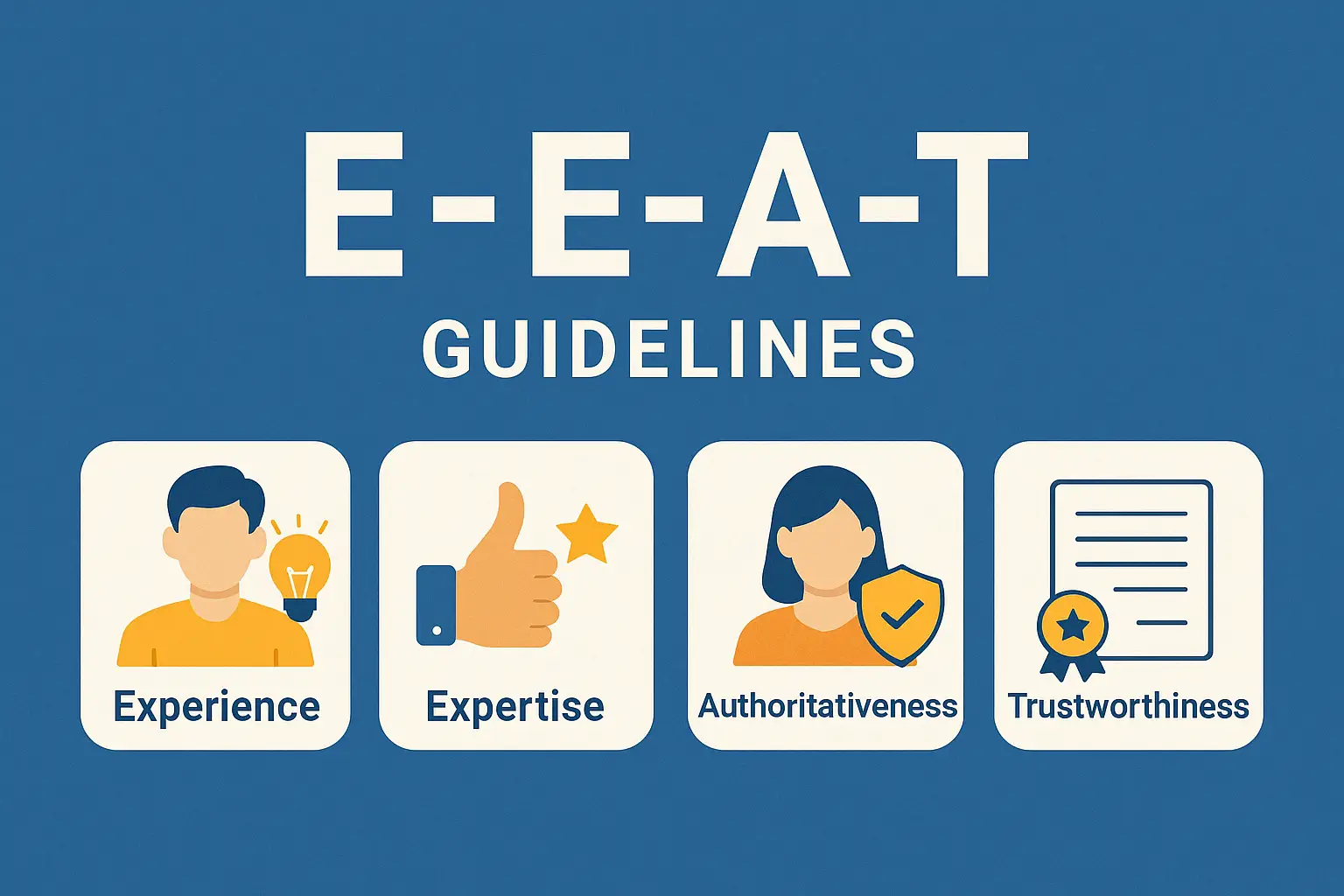
E-E-A-T stands for Experience, Expertise, Authoritativeness, and Trustworthiness. It's essentially Google's way of saying, "Show me you know what you're talking about, or I'm not sending visitors your way."
When Google updated their Search Quality Rater Guidelines in December 2022, they added that extra 'E' for Experience — because apparently three letters wasn't enough of an alphabet soup already. 🙄
Here's what each component actually means:
- Experience: Have you actually used the product? Lived with the condition? Visited the place? First-hand experience matters.
- Expertise: Do you have the qualifications or knowledge to speak on this topic?
- Authoritativeness: Are you or your website recognized as a go-to source in your field?
- Trustworthiness: Is your content accurate, transparent, and honest?
Think of E-E-A-T as Google's BS detector. And let me tell you, that detector is getting more sensitive by the day.

Why Should You Care?
"But Mark," I hear you ask, "my website sells handmade teapot cozies. Do I really need to worry about all this E-E-A-T malarkey?"
Short answer: Yes. Yes, you absolutely do.
Here's why:
- Rankings: Google rewards content that demonstrates E-E-A-T with higher rankings. Simple as.
- Traffic: Higher rankings = more traffic = more people seeing your gorgeous teapot cozies.
- Trust: E-E-A-T-focused content builds visitor trust. And trust leads to that beautiful sound of virtual cash registers ringing.
- Resilience: When Google does its next algorithm update (and it WILL), E-E-A-T-aligned sites typically weather the storm better.
But don't just take my word for it.
"Sometimes SEOs come to us or like mention that they’ve added EEAT to their web pages. That’s not how it works. Sorry, you can’t sprinkle some experiences on your web pages. It’s like, that’s that doesn’t make any sense." — Search Engine Journal
The Good, The Bad, and The Ugly: E-E-A-T in Action
Let's look at some real examples of content with and without E-E-A-T principles. I've changed some details to protect the innocent (and the guilty).
Example 1: Medical Advice
Without E-E-A-T:
Headaches can be cured by drinking more water and taking aspirin. Some people say lavender oil helps. Try these remedies and you'll feel better fast.
With E-E-A-T:
As someone who's suffered from chronic migraines for over 15 years, I've learned that hydration can help prevent tension headaches, though it's rarely enough for severe migraines. According to the NHS, "Aspirin and ibuprofen can help reduce headache symptoms, but should not be taken regularly without medical supervision." While some find aromatherapy soothing, Dr. Sarah Johnson, neurologist at King's College Hospital, emphasizes that "there's limited clinical evidence supporting essential oils as primary headache treatment."
See the difference? The second version:
- Shows personal experience with headaches
- Cites authoritative sources (NHS)
- Includes expert opinion (a named neurologist)
- Presents balanced, nuanced information rather than absolute claims
Example 2: Product Reviews
Without E-E-A-T:
The XYZ Blender is the best blender on the market. It has powerful blades and many speed settings. Everyone should buy this blender because it works great for all blending needs.
With E-E-A-T:
After using the XYZ Blender daily for the past 6 months (I've made approximately 180 smoothies, 24 soups, and countless batches of homemade nut butter), I can confidently say it outperforms my previous Vitamix in noise level and clean-up ease. However, it struggles with frozen fruits compared to higher-priced models. According to Which?'s 2024 blender reliability survey, the XYZ scored 4.2/5 for durability, placing it in the top 10% of consumer blenders. Worth noting: two professional chefs I interviewed for this review mentioned they prefer the PRO model for commercial kitchens.
The second version is:
- Specific about personal usage (demonstrating experience)
- Balanced with both pros and cons
- Backed by data and third-party testing
- Enhanced with additional expert opinions

7 Practical Ways to Boost Your E-E-A-T Score
Right, so how do you actually implement this stuff? Here are some practical tips that have worked wonders for my clients:
- Show Your Credentials Create detailed author bios that highlight qualifications, experience, and expertise. If you're a solicitor, mention your qualifications. If you're a carpenter, talk about your 20 years of experience.
- Back Up Claims Use citations, references, statistics from reputable sources. And for the love of all things digital, please LINK to those sources.
- Be Transparent Clearly disclose advertising relationships, affiliate links, and sponsored content. Google doesn't mind monetization; it minds deception.
- Update Regularly Old, outdated content screams "Don't trust me!" Update your cornerstone content at least annually.
- Get Those Reviews Customer reviews, testimonials, and case studies add vital trustworthiness signals.
- Showcase Expertise Include detailed FAQ sections answering common questions in depth. This demonstrates your knowledge and helpfulness.
- Be Human Share personal experiences and stories related to your topics. That first 'E' in E-E-A-T is all about experience, and nothing shows that better than authentic storytelling.
A Real-Life Success Story
One of our clients — let's call them "Yorkshire Tea Cozies" — was struggling to rank for their target keywords. Their product was brilliant, their technical SEO was spot-on, but Google just wasn't having it.
We implemented a comprehensive E-E-A-T strategy:
- Created detailed artisan profiles showing the 30+ years of experience their craftspeople had
- Added behind-the-scenes content showing how each tea cozy is handmade
- Included customer testimonials with verified purchase badges
- Published a series of articles about tea culture written by a certified tea sommelier
- Added transparent pricing and ethical sourcing information
The results? Organic traffic up 64% in three months. Conversion rate improved by 28%. Most importantly, they now rank on page one for their main target keywords.
Not too shabby for some "content tweaks," eh?

The Final Cuppa
Look, I get it. E-E-A-T feels like yet another hoop Google's making you jump through. But unlike some SEO trends that come and go faster than British summer weather, E-E-A-T is here to stay.
Why? Because at its core, it's not about gaming the algorithm — it's about creating genuinely helpful content from people who know what they're talking about.
And isn't that what the internet should be anyway?
If you're looking at your website content right now and feeling a bit overwhelmed, don't panic. At 365i, we've helped dozens of clients implement E-E-A-T principles that have dramatically improved their search performance. Our WordPress-optimized hosting provides the perfect foundation for your E-E-A-T-friendly content to shine.
Want to chat about how we can help your content meet Google's E-E-A-T standards? Drop us a line — we promise not to bombard you with more four-letter acronyms. Well, maybe just a few.
FAQ: E-E-A-T Guidelines
What does E-E-A-T actually stand for?
Great question—and no, it’s not a lunchtime reminder. E-E-A-T stands for Experience, Expertise, Authoritativeness, and Trustworthiness. It’s how Google decides if your content deserves the spotlight… or the SEO naughty step.
Is E-E-A-T a direct ranking factor?
Not exactly. It’s more like the judge behind the scenes, sipping coffee and scoring your site’s credibility. Google says E-E-A-T isn’t a single “ranking factor,” but it’s baked into the algorithms via quality signals.
Why should I care about E-E-A-T for my website?
Because no one trusts a dodgy website that looks like it was built in 2005 by a mysterious man named Gary. E-E-A-T helps you show Google (and humans!) that your content is legit, helpful, and created by people who know what they’re talking about.
Do I need to show the author of every blog post?
Yep, especially if you're dealing with Your Money or Your Life (YMYL) topics—like health, finance, or anything that could ruin someone’s day if they believed dodgy info. Add an author bio, a friendly face, and ideally some proof that they’re not just regurgitating ChatGPT scripts (I see you 👀).
Can small businesses compete with big brands on E-E-A-T?
Absolutely. In fact, small businesses often shine here because they’re more personal and authentic. Share your journey, show your face, and connect with your audience. People trust people—not faceless corporations.
How do I improve my site’s E-E-A-T score?
Start by weaving real-life experience into your content—share examples, tell stories, and be relatable. Back it all up by showing you're an expert in your field, whether that’s through your writing style, your credentials, or even your reputation. If others are talking about you online in a good way, that builds authority too. And don’t forget trust—make your site feel safe, professional, and transparent from the moment someone lands on it.
What’s the difference between expertise and experience?
Expertise is the kind of knowledge you get from learning, like studying or professional training. Experience is what comes from actually doing the thing—real-world stuff, the lessons you’ve learned along the way. Google’s ideal content has both: smart insights backed by hands-on know-how.
Need a website that not only looks great but ranks brilliantly too? Check out our WordPress hosting packages combined with our expert web design services.