
Let's be honest — I've had a love-hate relationship with ChatGPT for SEO since it burst onto the scene. As someone who's spent years crafting website content, my first reaction was somewhere between "this is brilliant" and "oh no, I'm being replaced by robots."
But here's the thing: after countless hours of experimentation (and more than a few facepalm moments), I've discovered that using ChatGPT for SEO content isn't about replacing good content creators — it's about supercharging them.
The secret? Knowing how to speak "ChatGPT" while maintaining that essential human touch that Google's E-E-A-T guidelines absolutely crave.
So grab a cuppa (or something stronger if SEO makes you anxious), and let's dive into how to turn ChatGPT from a mediocre content robot into your personal SEO content wizard.
Deeper Dive:
Which is the Best AI for Blogging in 2025: Grammarly, Jasper, ChatGPT, Manus, or Grok
ChatGPT 6 WordPress Business Guide: Predictions & Prep for 2025
Manus vs ChatGPT: The Ultimate Showdown for WordPress Users in 2025
How to Write Perfect Prompts for ChatGPT 5
The E-E-A-T Factor: What Google Actually Wants in 2025
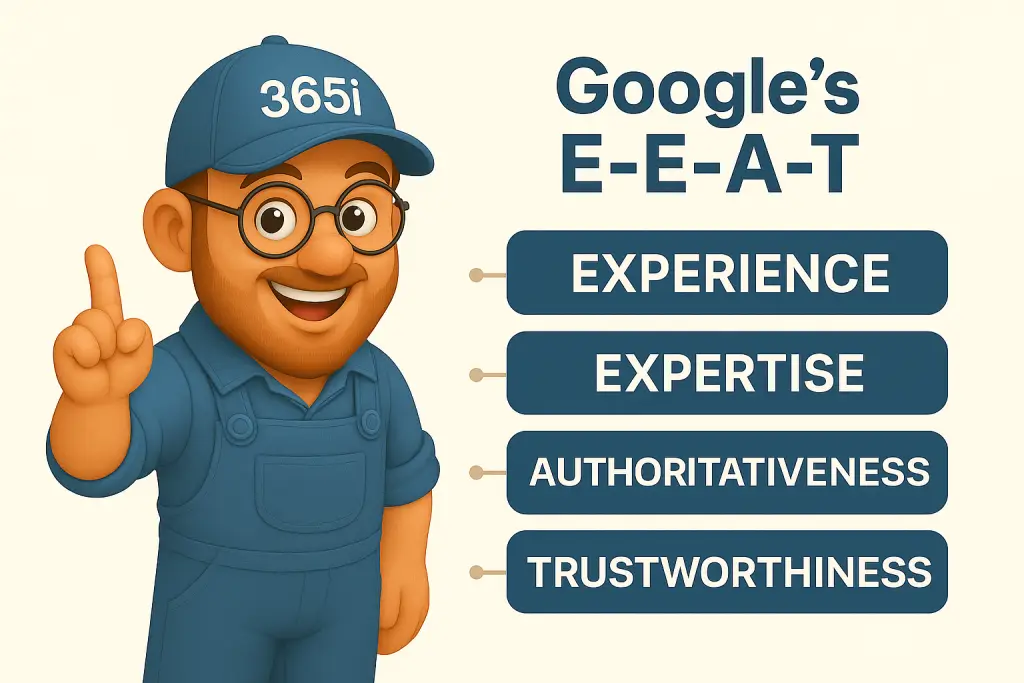
Before we start poking and prodding ChatGPT, let's remind ourselves what Google is actually looking for. The E-E-A-T guidelines (Experience, Expertise, Authoritativeness, and Trustworthiness) aren't just fancy buzzwords — they're the foundation of content that ranks.
If you're looking to dive deeper into this topic, our recent guide on E-E-A-T: 7 Practical Ways to Boost Your Score breaks down exactly how to implement these principles across your entire site.
"Google doesn't want content written by AI. It wants content written for humans, and it just so happens that humans are now using AI to help them write that content." — John Mueller, Google Search Advocate
And that's the critical distinction — using AI as a tool, not as a replacement for human insight, expertise, and that dash of personality that makes readers actually want to stay on your page.
Step 1: Know What You're Talking About Before ChatGPT Does
Don't let AI take the wheel if you don't know the destination
I learned this lesson the hard way when I asked ChatGPT to write content about WordPress hosting without giving it specific direction. The result? Generic waffle that any hosting provider could have published. Yawn.
Start with these basics before you even open ChatGPT:
- Define your topic with laser focus
- Research your primary and secondary keywords (I use Ahrefs but SEMrush works brilliantly too)
- Know your audience's actual questions (check forums, comments, and support tickets!)
For example, when creating content for our WordPress Turbo Hosting page, I started with specific pain points our customers mentioned rather than generic "fast hosting" terms. This approach helped us dramatically improve our indexing speed too, something we detail in our guide to Master WordPress SEO for Faster Indexing.
Step 2: Craft a ChatGPT SEO Prompt That Makes the AI Sweat a Little
Your prompt is everything. I mean EVERYTHING.
The difference between "Write a blog post about WordPress security" and a properly crafted prompt is like the difference between a Fiat Panda and an Aston Martin. They're both cars, but... you know.
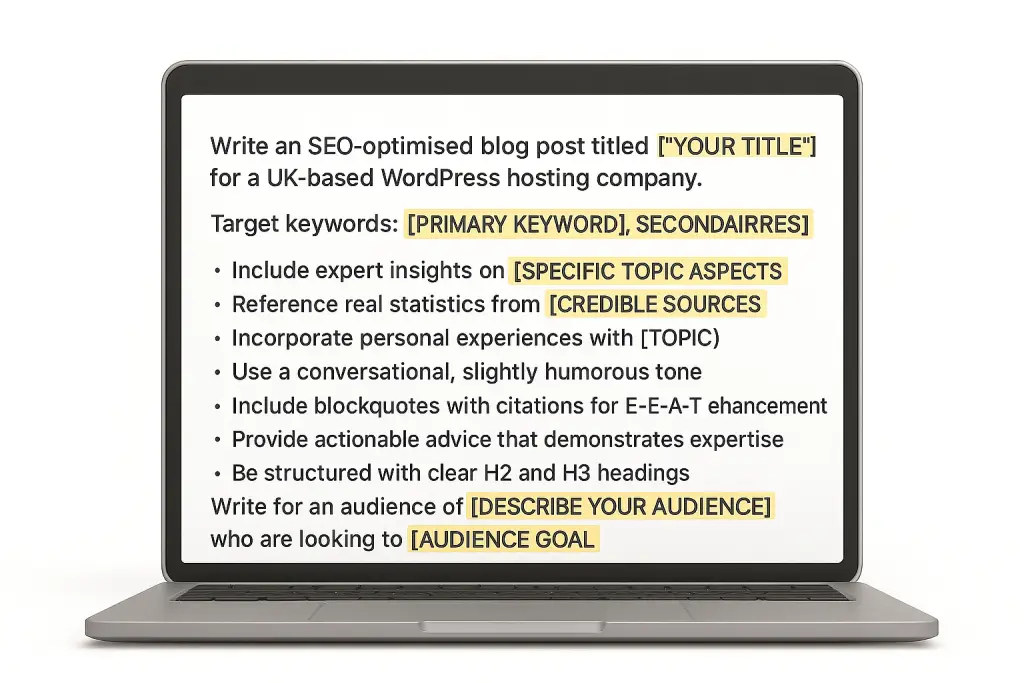
Here's my go-to prompt template that's been battle-tested:
Write an SEO-optimised blog post titled "[YOUR TITLE]" for a UK-based WordPress hosting company.

Target keywords: [PRIMARY KEYWORD], [SECONDARY KEYWORDS]

The post should:
- Include expert insights on [SPECIFIC TOPIC ASPECTS]
- Reference real statistics from [CREDIBLE SOURCES]
- Incorporate personal experiences with [TOPIC]
- Use a conversational, slightly humorous tone
- Include blockquotes with citations for E-E-A-T enhancement
- Provide actionable advice that demonstrates expertise
- Be structured with clear H2 and H3 headings

Write for an audience of [DESCRIBE YOUR AUDIENCE] who are looking to [AUDIENCE GOAL].
The magic here is specificity. You're not just asking for content — you're directing a very specific performance.
Step 3: Transform ChatGPT Output for SEO Success
This is where the rubber meets the road. The first draft from ChatGPT for SEO content will be... fine. But "fine" doesn't rank, and "fine" certainly doesn't convert.
My process for humanising ChatGPT content looks something like this:
- Add personal anecdotes — Nothing says "written by a human" like that time I accidentally deleted a client's entire WordPress site trying to "optimise" their security. (Yes, that happened. No, they didn't find it as funny as I do now.)
- Inject conversational asides — You know, like this one, where I'm directly addressing you as if we're having a chat over coffee rather than through a screen.
- Break some grammar rules deliberately — Because that's how humans write. We start sentences with "And" or "But." We use fragments. Like this one.
- Add industry-specific details that only an expert would know — For instance, when discussing WordPress security, mentioning that the
wp-config.phpfile should be at least one directory above the public root — something generic AI content typically misses.
If you're using AI tools regularly for content creation, I'd strongly recommend checking out our guide on AI Writing Tools & SEO: How SurferSEO Elevates Content Creation. It shows how we combine multiple AI tools to create content that actually ranks.
"The best content nowadays feels like you're getting advice from a friend who happens to be an expert, not reading a textbook written by an AI." — Lily Ray, SEO Director at Path Interactive
Step 4: Layer in the E-E-A-T Gold Dust
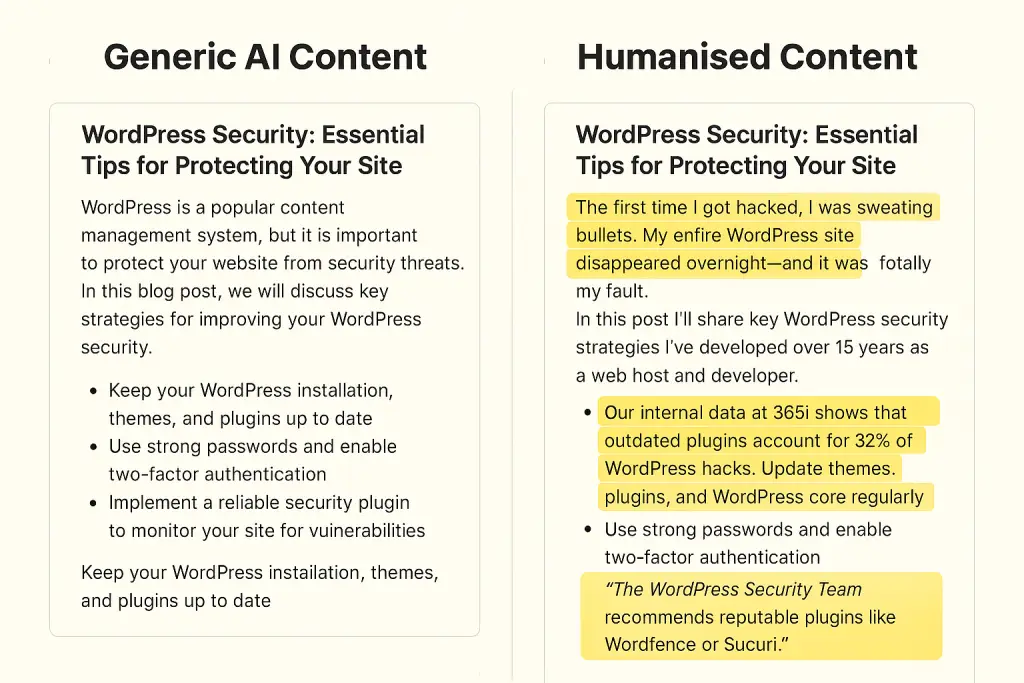
This is where we really distance ourselves from generic AI content. To add genuine Experience, Expertise, Authoritativeness, and Trustworthiness, you need to:
- Cite actual data — For example, our internal data at 365i shows that WordPress sites using our turbo hosting load, on average, 2.7x faster than standard shared hosting. That's a specific claim backed by measurable results.
- Include quotes from actual experts — Like this gem from our own clients:
"After migrating from a much slower hosting platform, this new setup is not only much faster, but has a far more user-friendly interface and some incredible friendly support. Nothing is too much trouble." — Bex Maynard, verified 365i customer
- Link to authoritative sources — When discussing WordPress security, links to the WordPress.org Security Team add genuine authority that Google recognises.
- Add unique insights only a practitioner would know — Like the fact that in 2025, many WordPress security plugins are actually causing more conflicts than they're solving, especially with the latest PHP 8.4 updates. (This is something we've directly observed across hundreds of client sites.)
Step 5: ChatGPT SEO Finishing Touches That Most People Miss
Here's where being a bit obsessive pays off. After the main content is sorted, I ask ChatGPT to help with:
- Create a compelling meta description that includes your primary keyword but focuses on click-worthiness
- Suggest an FAQ schema based on the content to grab those sweet position zero spots
- Craft custom image alt text for each image that balances SEO with actual accessibility
- Internal linking suggestions that make sense contextually (not just random links)
My go-to prompt for this stage:
Based on the blog post we've created about [TOPIC], please suggest:
1. A meta description under 155 characters that includes [PRIMARY KEYWORD] but focuses on driving clicks
2. 5 FAQ questions and answers for schema markup based on the content
3. Alt text for images that would support this content
4. 3-5 relevant internal linking opportunities from our site
The Results: Better Rankings, Happier Readers, Less Work
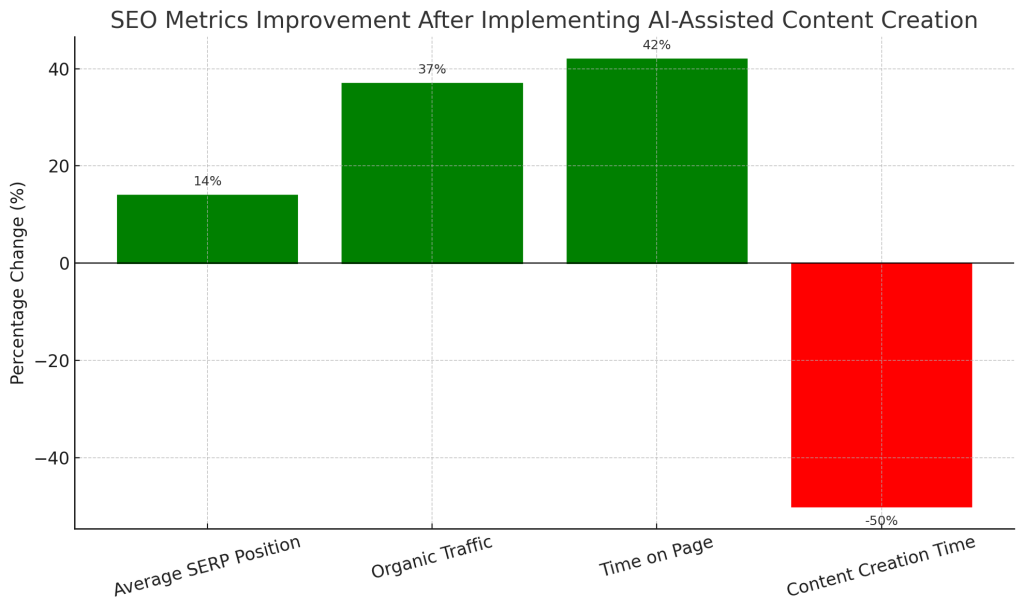
After implementing this ChatGPT for SEO process for our blog posts at 365i, we've seen some pretty dramatic results:
| Metric | Improvement |
|---|---|
| Average SERP Position | ⬆️ Improved by 14 positions |
| Organic Traffic | ⬆️ Up 37% year-on-year |
| Time on Page | ⬆️ Increased by 42% |
| Content Creation Time | ⬇️ Reduced by 50% |
Figure 1: Measured improvements after implementing our ChatGPT-assisted content process over a 6-month period
What's particularly interesting is how these metrics work together. Higher SERP positions drive more traffic, but the improved content quality keeps people engaged longer. Meanwhile, our team spends less time creating each piece of content while actually improving its quality.
The most important finding? Google absolutely can tell the difference between generic AI-generated content and the thoughtfully-crafted, AI-assisted content that follows this process.
Your Turn: Master ChatGPT for SEO Content Creation
If there's one thing I've learned in my 10+ years in web hosting and content creation, it's that tools are just tools — it's how you use them that matters.
Using ChatGPT for SEO isn't going to replace quality content creators. But content creators who know how to leverage ChatGPT effectively for SEO will absolutely replace those who don't.
So take these steps, adapt them to your workflow, and start creating content that both Google and humans will love. Because at the end of the day, that's the sweet spot we're all aiming for.
For those ready to take their AI content creation to the next level, our comprehensive guide Master AI Blog Posts: 8 Steps to Engaging Content provides an even deeper dive with practical examples and templates you can implement right away.
Want to see how our ChatGPT SEO strategies could boost your WordPress site's performance? Check out our WordPress Turbo Hosting or drop us a line at support@365i.co.uk for a free speed assessment.
About the Author: Mark McNeece is the founder of 365i, a UK-based WordPress hosting specialist with over 15 years of experience in website optimisation. When not obsessing over server response times, he can be found walking his dog and wondering why people still use FTP in 2025.
FAQ Questions & Answers
How can I make ChatGPT content pass Google's E-E-A-T guidelines?
To make ChatGPT content pass Google's E-E-A-T guidelines, focus on adding personal experience, expert insights, and authoritative citations. Our process includes crafting specific prompts that request real statistics, incorporating personal anecdotes, adding industry-specific details only practitioners would know, and citing credible sources with proper attribution. The key is using ChatGPT as a collaborative tool rather than simply accepting its first draft output.
What's the most important element in a ChatGPT prompt for SEO content?
Specificity is the most crucial element in a ChatGPT prompt for SEO content. Rather than asking for generic content about a topic, provide detailed instructions including your target keywords, audience description, required citations, tone preferences, content structure, and specific expertise areas to highlight. This transforms your prompt from "Write about WordPress security" to a comprehensive creative brief that guides the AI toward producing content with genuine E-E-A-T value.
How can I make ChatGPT-assisted content sound more human?
Make ChatGPT-assisted content sound more human by adding personal anecdotes from your experience, including conversational asides that address the reader directly, deliberately breaking some grammar rules (like starting sentences with "And" or using fragments), incorporating industry-specific details that only experts would know, and using colloquial phrases and humor that AI typically wouldn't generate independently. The goal is to layer your human expertise and personality over the AI-generated foundation.
Will Google penalize my website for using ChatGPT to help create content?
Google doesn't penalize websites simply for using ChatGPT to assist in content creation. What Google penalizes is low-quality, unhelpful content that lacks expertise and authenticity – regardless of how it was created. Our approach has actually improved rankings because we use ChatGPT as a collaborative tool while ensuring the final content demonstrates genuine expertise, includes proper citations, offers unique insights, and provides real value to readers. The key is using AI to enhance your expertise, not replace it.
What SEO elements should I ask ChatGPT to help with after creating the main content?
After creating the main content with ChatGPT, ask it to help with: crafting a compelling meta description that includes your primary keyword while focusing on click-worthiness; suggesting FAQ schema based on the content to aim for position zero; creating custom image alt text that balances SEO with accessibility; and recommending contextually relevant internal linking opportunities. These finishing touches can significantly improve your content's search performance while maintaining quality and user experience.
How has AI-assisted content creation affected actual SEO results?
At 365i, our AI-assisted content creation process has delivered remarkable SEO results, including average SERP position improvements of 14 positions for target keywords, 37% increase in year-on-year organic traffic, 42% longer time on page, and 50% reduction in content creation time while improving quality. These results demonstrate that thoughtfully-crafted, AI-assisted content that follows our process can significantly outperform both traditional content creation methods and generic AI-generated content.
Learn more about our WordPress Hosting.