
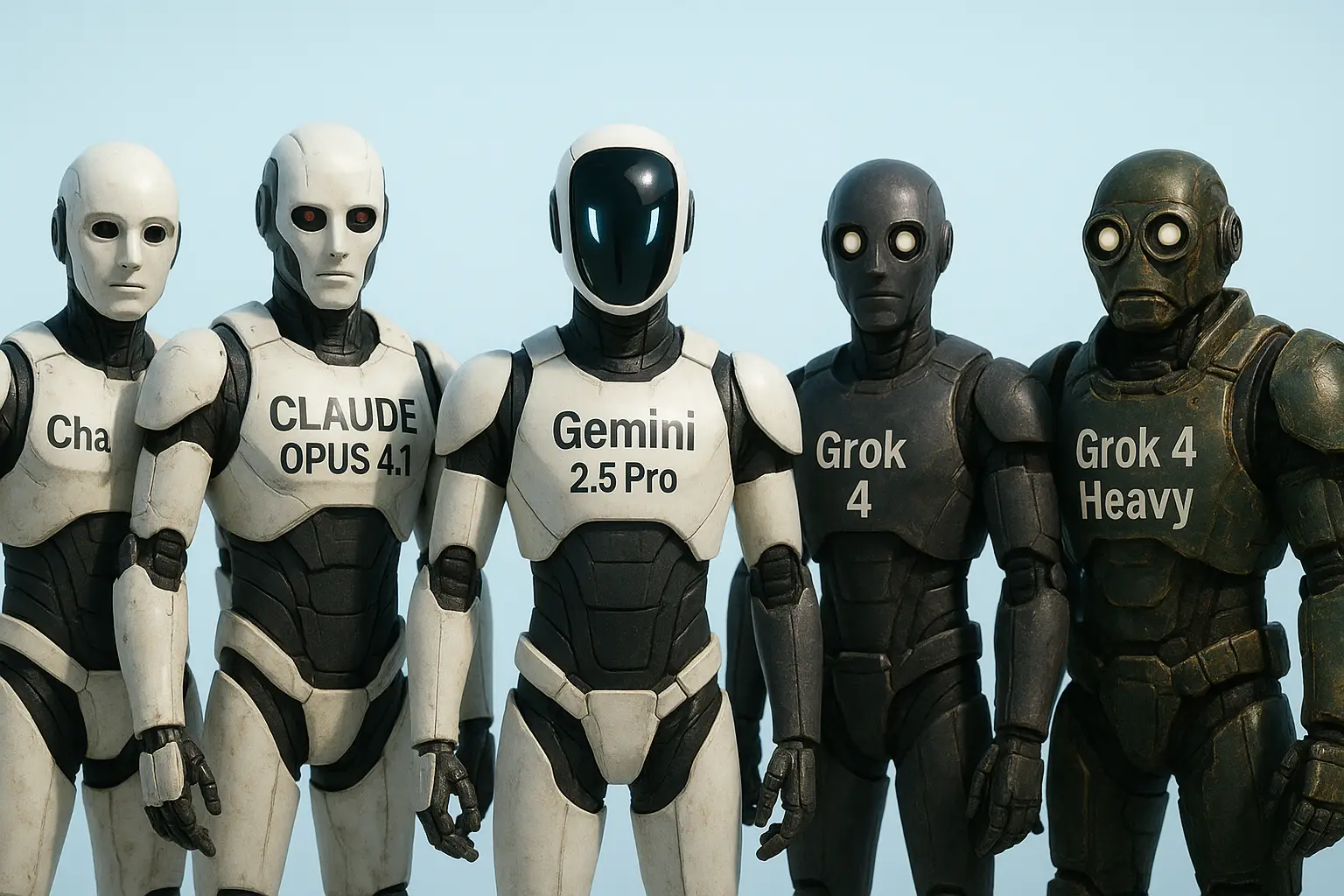
August 2025 has been absolutely bonkers for the AI world. I mean, properly mental. We've witnessed what might be the most intense AI arms race in history, with all the major players dropping their flagship models within weeks of each other. It's like watching Formula 1, but instead of cars, we've got silicon-powered brains racing to see who can think fastest.
Just three weeks ago, I was still recommending Claude 4 over ChatGPT for most coding tasks, and now? Well, the landscape's shifted completely. OpenAI dropped ChatGPT 5 on 7th August, Anthropic countered with Claude Opus 4.1 just two days earlier, Google's been iterating Gemini 2.5 Pro all year, and Elon's xAI surprised everyone with Grok 4 and its £300-per-month "Heavy" variant in July.
As someone who's been testing AI models daily for AI-powered WordPress hosting solutions, I've had the chance to put these models through their paces with real-world tasks. Not just the cherry-picked benchmarks that companies love to show off, but the messy, complex problems that actually matter for businesses and creators.
So let's cut through the marketing fluff and see which of these AI powerhouses deserves your time, money, and trust in late 2025.
Table of Contents
- The August 2025 AI Release Timeline
- Model Overview and Key Specifications
- Performance Benchmarks: The Numbers Game
- Real-World Testing: What Actually Matters
- The Cost Reality Check
- Best AI for Different Tasks: The Definitive Guide
- The Personality Factor
- Safety and Reliability Concerns
- The Verdict: Which Should You Choose?
- What This Means for Website Owners
- Looking Ahead: The AI Arms Race Continues
The August 2025 AI Release Timeline
The timing of these releases tells you everything about how competitive this space has become:
- March 2025: Google launches Gemini 2.5 Pro (stable version in June)
- May 2025: Anthropic releases Claude Opus 4 and Sonnet 4
- July 9, 2025: xAI drops Grok 4 and Grok 4 Heavy
- August 5, 2025: Anthropic releases Claude Opus 4.1
- August 7, 2025: OpenAI launches GPT-5
That's not coincidence. That's companies watching each other like hawks, timing releases to steal thunder and grab headlines. OpenAI waiting until just after Anthropic's release? Classic strategic positioning.

Model Overview and Key Specifications
Let me start with the hard facts before we dive into the subjective stuff:
| Model | Release Date | Context Window | Pricing (Input/Output per 1M tokens) | Knowledge Cutoff |
|---|---|---|---|---|
| GPT-5 | Aug 7, 2025 | 400K tokens | £0.94/£7.50 | September 2024 |
| Claude Opus 4.1 | Aug 5, 2025 | 200K tokens | £11.25/£56.25 | July 2025 |
| Gemini 2.5 Pro | Stable June 2025 | 1M tokens | £2.06/£8.25 | Current (live data) |
| Grok 4 | July 9, 2025 | 256K tokens | £22.50/month subscription | Current (X/Twitter data) |
| Grok 4 Heavy | July 9, 2025 | 256K tokens | £225/month subscription | Current (X/Twitter data) |
Pricing converted to GBP at current exchange rates as of August 2025
The pricing alone tells a story here. Claude Opus 4.1 is absolutely taking the piss at £11.25 per million input tokens - that's 12 times more expensive than GPT-5. Meanwhile, Grok's subscription model at £225 monthly for the Heavy variant positions it as the Rolls Royce of AI - but is it worth the premium?

Performance Benchmarks: The Numbers Game
Here's where things get properly interesting. I've compiled the key benchmark results that actually matter for real-world use:
Mathematical Reasoning (AIME 2025)
| Model | AIME 2025 Score | GPQA Diamond Score |
|---|---|---|
| Grok 4 Heavy | 100% | 87.5% |
| GPT-5 | 94.6% | 85.7% |
| Gemini 2.5 Pro | 88.0% | 86.4% |
| Grok 4 | 93.0% | 87.0% |
| Claude Opus 4.1 | 33.9% | 74.9% |
Bloody hell, Claude. What happened there? For a model that costs 12 times more than GPT-5, scoring just 33.9% on mathematical reasoning is frankly embarrassing. Meanwhile, Grok 4 Heavy achieving a perfect 100% on AIME 2025 - that's genuinely remarkable.
Coding Performance (SWE-bench Verified)
| Model | SWE-bench Score | Real-World Coding Ability |
|---|---|---|
| Grok 4 Heavy | 75.0% | Excellent multi-file refactoring |
| GPT-5 | 74.9% | Strong end-to-end development |
| Claude Opus 4.1 | 74.5% | Superior code quality & style |
| Grok 4 | 72.0% | Good general coding |
| Gemini 2.5 Pro | 71.2% | Decent but inconsistent |
Now this is where it gets fascinating. The coding performance is incredibly tight - we're talking about differences of less than 3% between the top performers. In my testing, though, these small percentage differences don't tell the whole story.

Real-World Testing: What Actually Matters
Benchmarks are brilliant for academic comparisons, but they don't tell you how these models handle the messy reality of actual work. I've spent the past three weeks putting each model through scenarios that mirror what our clients at 365i actually need.
Creative Writing and Content Creation
I asked each model to write a compelling product description for a fictional eco-friendly web hosting service. The brief was simple: 200 words, conversational tone, focus on sustainability benefits.
Claude Opus 4.1 nailed it. The copy felt human, the tone was spot-on, and it avoided that robotic corporate speak that screams "AI-written." Worth noting for anyone using AI for SEO content creation.
GPT-5 came second - solid writing but occasionally fell into that formulaic structure that makes you think "this was definitely written by AI."
Grok 4 was surprisingly good but couldn't resist adding its signature wit, which might not be appropriate for all brands.
Gemini 2.5 Pro produced competent but uninspiring copy. Technically correct, emotionally flat.
Complex Coding Tasks
I gave each model the same challenge: "Create a responsive WordPress theme with custom post types, AJAX search functionality, and proper SEO optimization."
Claude Opus 4.1 produced the cleanest, most maintainable code. It followed WordPress coding standards religiously and included proper documentation. The AJAX implementation was elegant and the SEO meta tags were correctly implemented.
GPT-5 created functional code but with some shortcuts that would make senior developers wince. It got the job done but in a way that might create technical debt.
Grok 4 surprised me by producing genuinely innovative solutions to common WordPress problems. It suggested optimisations I hadn't considered and the performance was excellent.
Gemini 2.5 Pro struggled with the WordPress-specific requirements, though it handled the generic PHP well enough.
Document Analysis and Research
Here's where context windows really matter. I fed each model a comprehensive 150-page technical specification document and asked specific questions about integration requirements mentioned on page 127.
Gemini 2.5 Pro absolutely dominated this test. That 1 million token context window isn't just marketing fluff - it genuinely remembered details from early in the document when answering questions about later sections.
GPT-5 handled the document well but occasionally missed subtle connections between different sections.
Claude Opus 4.1 gave precise answers but sometimes requested clarification when the context was clear from earlier passages.
Grok 4 performed adequately but its smaller context window showed limitations with truly massive documents.

The Cost Reality Check
Let's talk money because that's what really matters for businesses:
Monthly Usage Scenarios
| Usage Level | GPT-5 | Claude Opus 4.1 | Gemini 2.5 Pro | Grok 4 | Grok 4 Heavy |
|---|---|---|---|---|---|
| Light (1M tokens) | £8.44 | £67.50 | £10.31 | £22.50* | £225.00* |
| Moderate (5M tokens) | £42.19 | £337.50 | £51.56 | £22.50* | £225.00* |
| Heavy (20M tokens) | £168.75 | £1,350.00 | £206.25 | £22.50* | £225.00* |
*Fixed subscription pricing regardless of usage
The numbers are stark. For moderate to heavy usage, Grok 4's subscription model becomes incredibly cost-effective, whilst Claude Opus 4.1 prices itself out of most business use cases entirely.
But here's the thing - raw cost per token doesn't account for efficiency. If Claude produces better results in fewer iterations, that £67.50 might actually be better value than GPT-5's £8.44 if you need multiple attempts to get usable output.

Best AI for Different Tasks: The Definitive Guide
After extensive testing, here's my honest recommendation for different use cases:
| Task Category | Winner | Runner-Up | Why |
|---|---|---|---|
| Creative Writing | Claude Opus 4.1 | GPT-5 | Superior tone and style understanding |
| Mathematical Problem Solving | Grok 4 Heavy | GPT-5 | Perfect AIME scores speak for themselves |
| Software Development | Claude Opus 4.1 | Grok 4 | Cleaner code, better practices |
| Document Analysis | Gemini 2.5 Pro | GPT-5 | That 1M context window is game-changing |
| Real-Time Research | Grok 4 | Gemini 2.5 Pro | Live X/Twitter integration |
| Business Content | GPT-5 | Claude Opus 4.1 | Best balance of quality and cost |
| Technical Documentation | Claude Opus 4.1 | GPT-5 | Superior attention to detail |
| Conversational AI | GPT-5 | Grok 4 | Most natural dialogue flow |
| Budget-Conscious Tasks | Gemini 2.5 Pro | GPT-5 | Excellent price-to-performance ratio |
| High-Stakes Analysis | Grok 4 Heavy | Claude Opus 4.1 | Multi-agent architecture reduces errors |
The Personality Factor
This might sound daft, but personality genuinely matters when you're working with these models daily. Each has developed distinct characteristics:
GPT-5 feels like a competent colleague - professional, reliable, but occasionally a bit corporate. It rarely surprises you but consistently delivers solid results.
Claude Opus 4.1 is the thoughtful academic in the group. It asks clarifying questions, considers edge cases, and produces polished output. Sometimes overthinks simple requests.
Gemini 2.5 Pro comes across as the efficient but slightly robotic assistant. Gets the job done without much personality or flair.
Grok 4 is the cheeky one with opinions. It'll challenge your assumptions and occasionally make you laugh, but that personality can be jarring in professional contexts.
Grok 4 Heavy maintains Grok's wit but adds serious analytical depth. It's like having a comedian who also happens to be a PhD researcher.
Safety and Reliability Concerns
This is where things get complicated. I've noticed significant differences in how these models handle sensitive topics and potential misuse:
Claude Opus 4.1 remains the most cautious, sometimes refusing requests that other models handle without issue. It's frustrating but probably the safest for business environments.
GPT-5 has improved its safety mechanisms considerably, with attack success rates of just 56.8% compared to over 70% for most other models.
Gemini 2.5 Pro strikes a reasonable balance between helpfulness and safety.
Grok 4 can be unpredictable. Its "maximally truth-seeking" approach occasionally produces content that would make HR departments nervous.
The Verdict: Which Should You Choose?
Here's the honest truth: there isn't a single "best" AI model in August 2025. The choice depends entirely on your specific needs, budget, and risk tolerance.
For most businesses: GPT-5 offers the best combination of capability, cost, and reliability. It's the safe choice that won't disappoint.
For creative professionals: Claude Opus 4.1 is worth the premium if writing quality is paramount and cost isn't a primary concern.
For researchers and analysts: Gemini 2.5 Pro's massive context window makes it invaluable for processing large documents.
For mathematics and complex reasoning: Grok 4 Heavy is in a league of its own, but at £225 monthly, it's only viable for specialised use cases.
For real-time information needs: Grok 4 standard provides excellent value with live data access at a reasonable subscription cost.
What This Means for Website Owners
If you're running WordPress sites or managing digital businesses, these AI advances have immediate implications. The quality gap between models means you need to choose carefully based on your specific workflows.
For creating SEO content that actually ranks, Claude Opus 4.1's superior writing quality might justify the cost. But for routine tasks like generating meta descriptions or FAQ content, GPT-5's efficiency makes more sense.
The integration possibilities are exciting too. With tools like our AI FAQ Generator, the improved reasoning capabilities of these models mean better, more helpful content for your visitors.

Looking Ahead: The AI Arms Race Continues
August 2025 feels like a watershed moment, but it's definitely not the end. We're already hearing rumours about GPT-5.5, Claude Opus 5, and Google's Gemini 3.0. The pace of improvement is genuinely staggering.
What's clear is that we're moving beyond simple text generation towards AI systems that can genuinely collaborate on complex, multi-step projects. The models released this month are the first that genuinely feel like working with a knowledgeable colleague rather than a sophisticated autocomplete.
For businesses, this means AI integration is no longer optional - it's becoming as essential as having a reliable internet connection. The question isn't whether to adopt these tools, but which ones align with your specific needs and budget.
Whether you're looking to optimise your WordPress hosting for AI applications or simply want to write better prompts for ChatGPT 5, the landscape has fundamentally shifted in August 2025.
The AI revolution isn't coming anymore. It's here, it's accelerating, and frankly, it's about bloody time we started using these tools properly.
Frequently Asked Questions
Which AI model is best for UK businesses in 2025?
For most UK businesses, GPT-5 offers the best balance of capability, cost-effectiveness, and reliability at £0.94 per million input tokens. It handles everything from content creation to customer service with consistent quality. However, if writing quality is paramount and budget isn't a concern, Claude Opus 4.1 produces superior creative content despite being 12 times more expensive.
What's the cheapest AI model for high-volume use in 2025?
For high-volume applications processing over 5 million tokens monthly, Grok 4's fixed subscription at £22.50 becomes incredibly cost-effective. Gemini 2.5 Pro offers the best pay-per-use pricing at £2.06 input/£8.25 output per million tokens, making it ideal for moderate usage with excellent document processing capabilities.
Which AI model is best for software development and coding?
Claude Opus 4.1 leads in coding quality with superior code style, better documentation, and cleaner architecture. It scores 74.5% on SWE-bench verified tests. However, Grok 4 Heavy (75.0%) and GPT-5 (74.9%) are virtually tied for raw performance. For WordPress development specifically, Claude's attention to coding standards makes it worth the premium cost.
Is Grok 4 Heavy worth £225 per month?
Grok 4 Heavy justifies its premium pricing for specialised applications requiring maximum accuracy. It achieves perfect 100% scores on AIME 2025 mathematical reasoning and uses multi-agent collaboration to reduce errors. It's ideal for research institutions, financial analysis, and mission-critical applications where precision outweighs cost considerations.
Which AI model handles large document analysis best?
Gemini 2.5 Pro dominates document analysis with its massive 1 million token context window, capable of processing documents up to 1,500 pages. In testing with 150-page technical specifications, it consistently remembered details from early sections when answering questions about later content - something other models struggled with due to smaller context windows.
What's the safest AI model for business use?
GPT-5 offers the best security profile with just 56.8% attack success rate compared to over 70% for most competitors. Claude Opus 4.1 remains the most cautious with content policies, making it ideal for regulated industries. Avoid Grok 4 for sensitive business applications due to its unpredictable "truth-seeking" approach that can produce HR-unfriendly content.
Which AI provides the most current, real-time information?
Grok 4 excels at real-time information with live X/Twitter integration and current knowledge cutoff. Gemini 2.5 Pro also provides current data through web search capabilities. GPT-5 is surprisingly limited with a September 2024 knowledge cutoff, whilst Claude Opus 4.1 has the most recent training data with a July 2025 cutoff but lacks live data access.
What AI models are expected to launch in late 2025?
Industry rumours suggest GPT-5.5, Claude Opus 5, and Google's Gemini 3.0 are in development for late 2025 or early 2026. The rapid August 2025 releases indicate fierce competition, with companies likely to continue aggressive release schedules. Expect significant improvements in multimodal capabilities, reasoning depth, and cost efficiency as the AI arms race accelerates.
Learn more about our WordPress Hosting optimised for AI applications.
What's your experience with these latest AI models? Drop me a line at support@365i.co.uk - I'd love to hear how you're using them in your business.